
Hire a small business accountant when keeping accurate books, understanding your results, or preparing for taxes exceeds the time or knowledge you can reliably provide. In 2026, the decision should turn on your records and upcoming decisions—not a universal revenue threshold; hiring help still requires you to provide complete documents and answer questions.
- Hire a small business accountant when monthly bookkeeping falls behind or financial decisions need more than transaction entry.
- Vikprocpa serves Newark and Bay Area businesses seeking bookkeeping, accounting, and business tax preparation.
- Choose monthly bookkeeping for recurring recordkeeping; add accounting support when you need interpretation and tax planning.
- Before a consultation, identify unfinished reconciliations, unanswered tax questions, and who currently maintains your records.
When should you hire a small business accountant?
Hire before an unresolved bookkeeping problem becomes the basis for a tax return or business decision. Warning signs include accounts that do not match statements, unexplained profit changes, repeated uncertainty about tax payments, and books you cannot use without first correcting them.
For Newark and surrounding Bay Area owners, Vikprocpa offers bookkeeping, accounting, tax preparation, and financial planning. Start by identifying the work you need rather than requesting an undefined accounting package.
| Approach | Best for | Main advantage | Main limitation |
|---|---|---|---|
| Owner-managed bookkeeping | Owners who can maintain and explain accurate records | Direct familiarity with transactions and control over recordkeeping | The owner must supply the time and accounting knowledge |
| Monthly bookkeeping support | Businesses that need consistent transaction records and account reconciliation | Keeps recurring recordkeeping on a defined schedule | Transaction maintenance alone does not answer every tax or financial question |
| Small business accountant | Owners who need accounting interpretation alongside recordkeeping or tax support | Connects financial records with reporting and business questions | The engagement still needs a clear scope and timely owner input |
These approaches can overlap. You can retain responsibility for invoices and receipts while assigning monthly bookkeeping and accounting review to outside help; the important distinction is who owns each task.
Why this matters
Bookkeeping records what happened. Accounting helps you understand what those records mean, while tax preparation uses relevant records to prepare required returns.
When these responsibilities are unclear, an owner can mistake entered transactions for finished books. A monthly process should make the status of your records clear enough that you know what is complete, what remains unresolved, and which decisions need professional attention.
Your books no longer match your accounts
Unreconciled accounts are a reason to get help, even when sales appear healthy. Reconciliation means comparing an account's bookkeeping balance with its statement and explaining differences, rather than changing entries simply to make totals match.
Look for these warning signs:
- Bank or credit card balances differ from your accounting records without an explanation.
- Transfers appear as income or expenses instead of movements between accounts.
- Loan payments are recorded entirely as expenses without separating principal and interest.
- Personal purchases and business transactions remain mixed together.
- Old questions carry into each new monthly close.
A monthly close is the process of finishing and checking the records for a reporting period. If no one can explain when the books are closed or what was checked, ask an accountant to assess the records before relying on them.
Hypothetical example: An owner transfers money between business accounts, and both entries are categorized incorrectly. The dashboard looks active, but the recorded income and expenses do not describe the business accurately; review should resolve the transfer before the owner uses those totals.
Monthly bookkeeping keeps slipping behind
An occasional unanswered transaction is different from a recurring backlog. Hire support when bookkeeping repeatedly waits until a tax appointment, a financing request, or a quiet period that never arrives.
The consequence is not just unfinished administration. An outdated report describes an earlier version of your business, so it cannot fully answer questions about your current position.
Ask whether you can maintain 12 monthly closes across a full year, including busy periods. That is a planning check, not a qualification rule: if your process depends on spare time, assign recurring work explicitly instead of assuming it will get done.
Hypothetical example: A business owner keeps receipts but postpones reviewing bank activity. Monthly bookkeeping would address the recurring work; a separate cleanup project would address the backlog. Ask about both, because completing past records and maintaining future records are different responsibilities.
You have reports but cannot explain the results
You need accounting help when you can produce reports but cannot use them to answer ordinary business questions. Start with 2 reports: a profit and loss statement and a balance sheet.
A profit and loss statement summarizes revenue and expenses over a period. A balance sheet shows assets, liabilities, and equity at a particular date; neither report replaces checking the underlying records.
Questions worth bringing to an accountant include:
- Why does reported profit differ from the money in the bank?
- How are owner contributions and withdrawals recorded?
- Which customer balances remain unpaid?
- Which obligations are recorded but not yet paid?
- Does the reporting method fit how the business needs to track activity?
Profit and cash are not interchangeable. Borrowing, loan repayments, owner transactions, and the timing of collections or payments can affect cash differently from reported profit.
Ask for explanations tied to your actual reports. A useful discussion should leave you understanding the issue, not simply holding another document.
Tax preparation is exposing year-round record problems
Business tax preparation is a reason to hire an accountant when the return repeatedly reveals missing records or unresolved classifications. The better response is to correct the recordkeeping process, not just repeat the same cleanup at filing time.
Tax preparation and tax planning are different services. Preparation concerns completing returns; planning considers how applicable tax rules affect decisions before those decisions are final.
For your 2026 tax planning, raise questions about business changes while you can still evaluate the choices. A change in ownership, a substantial purchase, or hiring employees deserves a discussion about the relevant accounting and tax responsibilities—not an assumption that the bookkeeping software will handle everything.
Do not assume monthly bookkeeping includes return preparation, estimated-tax calculations, or every planning discussion. Confirm those responsibilities in the engagement and identify what information the accountant needs from you.
Why the timing of an accounting hire varies
There is no universal sales figure that tells every owner to hire an accountant. The right timing depends on the work your business creates and your ability to complete it accurately.
- Record complexity: Payroll, loans, inventory, and multiple accounts create different recordkeeping requirements.
- Owner capacity: A process that works during a quiet period still needs an owner when business activity increases.
- Record condition: Current, reconciled books require different work from incomplete records with unresolved balances.
- Decision needs: Hiring, borrowing, ownership changes, and business purchases introduce questions beyond transaction entry.
- Reporting responsibilities: Tax preparation, lender requests, and internal management reporting can require different information.
- Division of work: Keeping invoicing in-house while outsourcing reconciliation creates a different engagement from assigning all recurring bookkeeping.
Use these factors to describe your situation rather than compare your business with someone else's revenue. A smaller business with unresolved records can need help before a larger business with a well-maintained accounting process.
What should monthly bookkeeping and accounting cover?
A monthly engagement should state what gets done, who does it, and how unanswered questions reach you. Do not treat the word monthly as a complete service description.
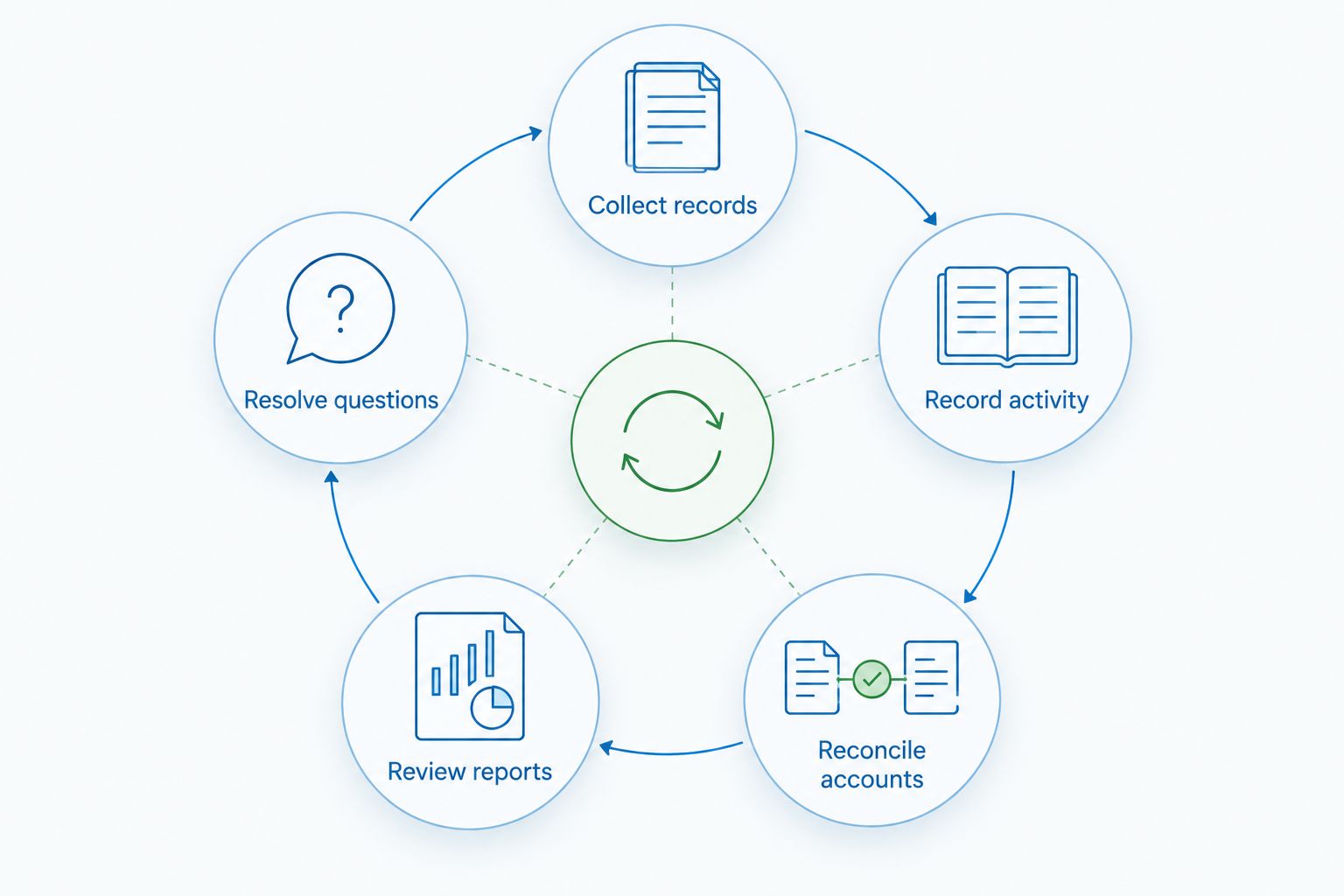
Use this proposed workflow to evaluate an engagement:
- Collect records: Identify the statements, receipts, payroll information, and other documents needed for the period.
- Record activity: Classify transactions and distinguish business activity from transfers and owner transactions.
- Reconcile accounts: Compare the books with relevant statements and investigate differences.
- Review reports: Check financial statements and discuss items that need explanation.
- Resolve questions: Assign outstanding items and carry confirmed corrections into the records.
The sequence matters because reports depend on the records beneath them. Reviewing a polished report before resolving incorrect transactions does not make the underlying figures dependable.
For your 2026 bookkeeping arrangement, document how corrections and unanswered questions will be handled. Also ask which services sit outside the recurring scope, including historical cleanup, payroll work, business tax preparation, and tax planning.
A written scope helps both sides distinguish routine work from a new request. It also gives you something concrete to revisit when your business changes.
How should you prepare for an accountant consultation?
Bring a clear description of the problem, not a perfectly organized accounting file. An initial conversation is more useful when you can identify where the current process breaks down.
Prepare these items for a 2026 consultation:
- The accounting software or recordkeeping method you currently use.
- The latest period for which accounts have been reconciled.
- Your current financial reports, if you have them.
- A description of any bookkeeping backlog or disputed balances.
- The business changes and tax questions you want to discuss.
- A list of tasks you want to retain versus assign.
Ask 3 questions before agreeing to ongoing work: What is included? What must I provide? How will unresolved questions and financial results be explained?
Vikprocpa is a fit for Newark and Bay Area business owners seeking bookkeeping, accounting, and tax services with personal attention and clear explanations. Discuss your records and desired responsibilities directly; do not assume every service is included in the same engagement.
If you are comparing a Fremont CPA with other Bay Area options, use the same scope questions. Location alone does not establish who will maintain your books, explain your reports, or prepare your business returns.
Discuss your monthly accounting needs
Explain your bookkeeping backlog, reporting questions, and business tax preparation needs.
Can you keep doing your own bookkeeping?
You can keep your own bookkeeping when you can maintain accurate records and understand the reports they produce. Outside support is not a requirement simply because you own a business.
The limitation is responsibility: software does not remove your obligation to review categories, supply documents, and resolve exceptions. If those tasks are consistently unfinished, retaining full ownership of the process is no longer working.
Should you hire a bookkeeper or an accountant first?
Start with bookkeeping support when the central problem is recurring transaction maintenance. Ask for accounting involvement when records need interpretation, adjustments, or coordination with tax questions.
Titles alone do not settle the choice. Compare the actual tasks in the proposed scope, including who reviews the work and who answers questions outside routine recordkeeping.
FAQ
When should I hire a small business accountant in 2026?
Hire a small business accountant when you cannot consistently maintain accurate books or need help interpreting financial and tax questions. Unreconciled accounts, recurring backlogs, and unexplained reports are practical reasons to start a conversation.
Do I need an accountant if I already use bookkeeping software?
Bookkeeping software does not replace reviewing transactions, reconciling accounts, or interpreting results. You need accounting help when those responsibilities exceed your knowledge or available time.
Should I wait until tax season to hire an accountant?
Do not wait until tax season if your records are incomplete or a business decision needs tax input. Monthly bookkeeping and advance planning address different needs from preparing a return.
What should I ask a monthly bookkeeping provider?
Ask which accounts are reconciled, which reports are provided, what records you must supply, and how questions are resolved. Confirm separately whether cleanup, business tax preparation, and tax planning are included.
Can Vikprocpa help with bookkeeping and business taxes?
Vikprocpa offers bookkeeping, accounting, and tax preparation for businesses in Newark and the greater Bay Area. Discuss your recurring bookkeeping needs and confirm the scope of any related tax services.
How do I compare a Fremont CPA with another Bay Area accountant?
Compare the proposed responsibilities, communication process, and explanations of your financial reports. Ask who maintains the records, who reviews them, and how business tax questions are handled.
One last thing
Ask an accountant to explain an actual report, not just describe a service. Choose a balance or expense you do not understand and ask what records would establish whether it is correct.
That conversation tests the help you need: clear explanations connected to your business. You should leave knowing the next action, which records support it, and who is responsible for completing it.