
Prepare for business tax preparation by bringing your bookkeeping up to date, reconciling bank and credit card accounts, gathering supporting records, and identifying business changes your CPA needs to review. Tax forms alone do not show whether your books are complete; you also need accurate balances, documented expenses, and a clear separation between business activity and owner transactions.
- Business tax preparation starts with reconciled monthly bookkeeping, not a folder of tax forms.
- Vikprocpa suits Newark and Bay Area owners seeking bookkeeping, accounting, and business tax preparation from a CPA firm.
- Resolve unclear transactions before filing, and discuss tax planning separately from preparing the return.
- Bring financial reports, supporting documents, payment records, and questions to your CPA consultation.
How do you prepare for business tax preparation?
Start with complete books, then gather the documents that support them. For your 2026 preparation process, work through the steps below before treating your financial reports as ready for filing. If you need ongoing help rather than a year-end handoff, Vikprocpa provides bookkeeping, accounting, and tax services for individuals and businesses in Newark and the greater Bay Area.
1. Confirm which business and reporting period you are preparing
Tell your CPA the business's legal name, ownership structure, and tax classification. These are not interchangeable: a legal business structure does not, by itself, establish every federal tax filing requirement.
Confirm the beginning and end of the period covered by the return. Also identify any ownership changes, new entities, business closures, or tax elections so your CPA can determine which records and filings apply.
Bring your prior return and any tax agency notices. These provide context for balances carried forward, previous filing positions, and unresolved correspondence; they do not replace the current period's books.
2. Finish and reconcile monthly bookkeeping
Reconciliation means comparing your accounting records with an outside statement and explaining the differences. Match every business bank and credit card account to its statements, including accounts you stopped using during the period.
For a calendar-year business, check that all 12 months are covered. An incomplete month can leave income, expenses, or transfers out of the annual reports even when the final bank balance looks reasonable.
Review payment processor activity, loan balances, and transactions waiting for categorization. A transfer between your own accounts is not a new sale, and a loan deposit is not ordinary sales revenue.
3. Assemble financial reports and supporting records
Prepare a profit and loss statement and a balance sheet for the reporting period. The profit and loss statement summarizes income and expenses; the balance sheet shows assets, liabilities, and equity at a particular date.
Use this checklist to connect reports with evidence:
| Record | What it helps establish | What to check |
|---|---|---|
| Bank and credit card statements | Account activity and ending balances | Missing accounts, duplicates, and unexplained differences |
| Sales and payment processor reports | Customer payments and processing activity | Gross receipts, fees, refunds, and transfers |
| Expense receipts and invoices | What you bought and its business purpose | Missing documentation and unclear descriptions |
| Payroll records | Wages, withholding, and employer payroll activity | Agreement with payroll reports and accounting entries |
| Loan statements | Borrowing, repayments, and interest | Separation of principal and interest |
| Asset purchase and disposal records | Business property acquired or removed | Purchase details, business use, and sale documents |
| Prior returns and tax notices | Previous filings and agency correspondence | Items requiring follow-up |
Not every row applies to every business. Tell your CPA when an item does not apply rather than leaving an unexplained gap in the document request.
4. Separate business activity from owner activity
Identify personal purchases paid through business accounts and business purchases paid personally. Give each transaction a description and supporting document so the accounting treatment can be reviewed.
Owner contributions and withdrawals also need separate treatment. Moving money between you and the business does not automatically create deductible spending or taxable sales revenue.
Do not force an unclear transaction into an expense category just to finish the books. Keep a short questions list and resolve it with your accountant before relying on the reports.
5. Gather tax payments and explain business changes
Collect confirmations for estimated tax payments and other relevant tax payments. If you paid quarterly, gather the records for all 4 quarters, then have your CPA confirm how those payments apply to the return being prepared.
List changes that affected the business: hiring employees, buying equipment, adding owners, opening operations elsewhere, or changing how customers pay. Explain what happened and provide the related documents rather than guessing at the tax result.
For your 2026 consultation, distinguish a completed transaction from something you are considering. A planned purchase belongs in a planning discussion; a completed purchase needs accurate records and appropriate reporting.
6. Agree on responsibilities before work begins
Ask who will resolve bookkeeping questions, prepare accounting adjustments, supply missing records, and review the completed return with you. Confirm how documents will be shared and how questions should be submitted.
Request a clear description of the work included. Monthly bookkeeping, historical cleanup, tax preparation, and tax planning address different needs; do not assume one engagement includes all of them.
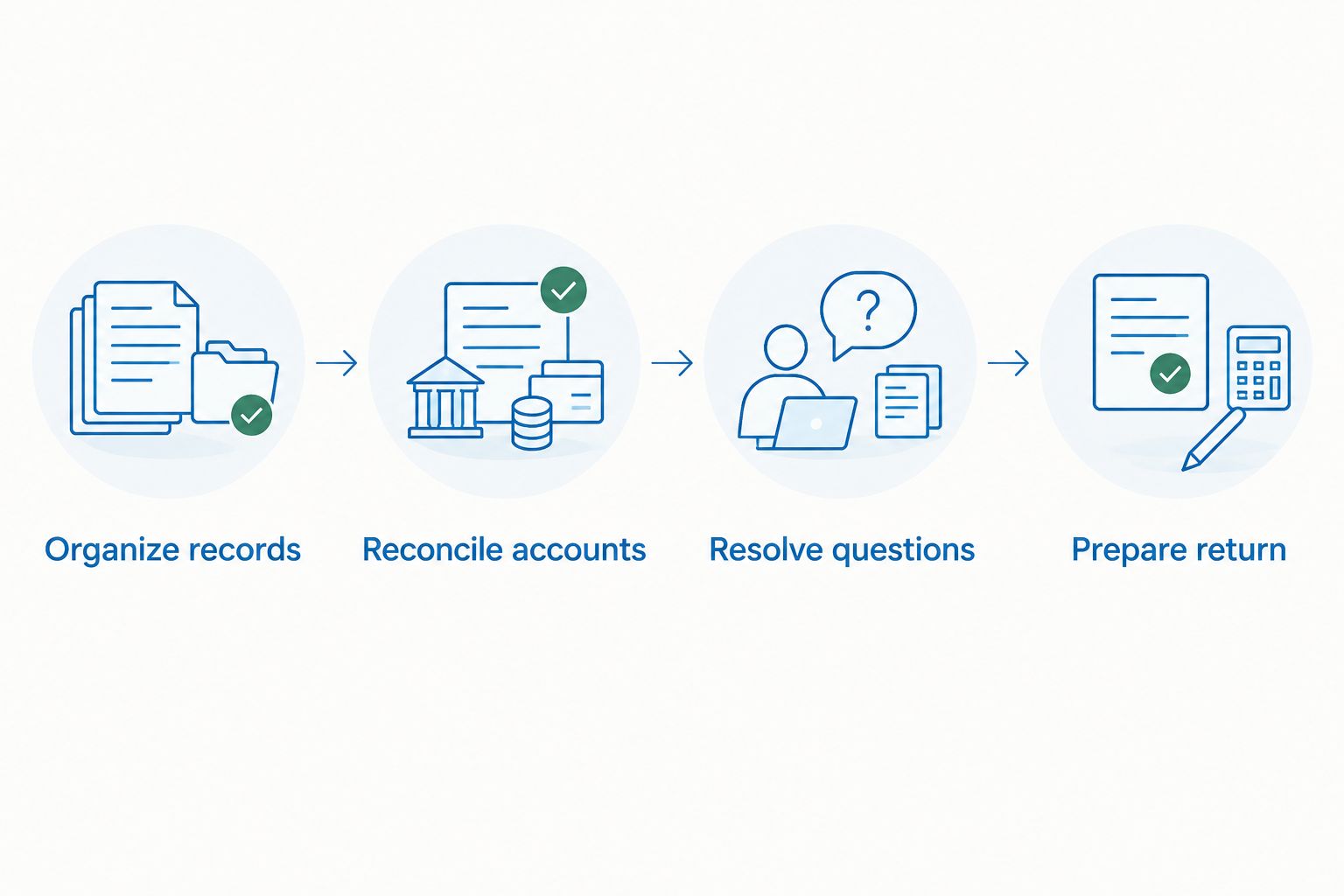
A useful handoff follows this sequence: organize records, reconcile accounts, resolve questions, and prepare the return. Skipping the questions stage leaves uncertainty inside the numbers.
Why this matters
Business tax preparation uses the financial story your records tell. If those records mix transfers with revenue or personal spending with business expenses, the filing process first becomes an accounting cleanup project.
Monthly bookkeeping gives you a recurring point to catch these issues while transactions are easier to explain. It also gives tax planning a usable starting point: current reports rather than an incomplete picture assembled after decisions are final.
For 2026, judge readiness by whether the balances are supported—not whether every document has been uploaded. A full folder can still contain incomplete books.
Should you use monthly bookkeeping or year-end cleanup?
Use monthly bookkeeping when you need current financial information throughout the year. Year-end cleanup addresses accumulated gaps, but it does not provide timely reports during the months already past.
These are workflow choices, not interchangeable service promises. Compare them against your ability to maintain records and review questions consistently.
| Approach | Best for | Main benefit | Main limitation |
|---|---|---|---|
| Owner-managed monthly books | Owners who can maintain and review records consistently | Direct involvement in transaction details | Requires the owner's time and accounting judgment |
| Ongoing professional bookkeeping | Owners seeking recurring accounting support | A regular process for recording and reconciling activity | Still requires the owner to provide documents and explanations |
| Year-end cleanup | Businesses with historical gaps to resolve | Addresses records needed for an unfinished reporting period | Does not replace current reporting during that period |
A CPA firm does not remove your role in explaining business activity. You know why a payment was made, whether a purchase had personal use, and whether an apparent customer payment was actually a transfer.
Vikprocpa's bookkeeping and accounting services fit owners seeking support alongside business tax preparation. Confirm the scope of recurring work, how questions are handled, and which responsibilities remain with you before engaging the firm.
Hypothetical example: mixed personal and business spending
Suppose you pay for a personal purchase with the business card and later reimburse the business. Without clear descriptions, the purchase and reimbursement can be misclassified as an expense and income.
The practical fix is to flag both transactions, retain the supporting details, and ask your accountant to record the owner activity correctly. The example illustrates a bookkeeping decision, not a client result or a promised tax outcome.
Hypothetical example: payment processor deposits
Suppose a payment processor deposits customer receipts after deducting processing fees. Recording only the deposit as sales can obscure the relationship between gross receipts, fees, and refunds.
Provide the processor report with the bank statement so your bookkeeper can reconcile the activity. The bank deposit and the sales report serve different purposes; one does not automatically replace the other.
Why business tax preparation work varies
The work required depends on what happened in the business and how clearly the records explain it. Use these factors to describe your situation during a consultation:
- Bookkeeping completeness: Missing months or unreconciled accounts require attention before the reports can support preparation.
- Business structure and ownership: Your CPA needs the entity details, tax classification, and ownership changes to assess filing requirements.
- Payroll activity: Employee wages and related payroll records must be considered alongside the books.
- Business property: Equipment purchases, disposals, and mixed personal use require supporting details.
- Transaction clarity: Unexplained transfers, owner spending, and payment processor activity create questions that documents alone do not answer.
- Planning needs: Preparing a return reports activity; evaluating a proposed business decision is a separate conversation.
For 2026, describe these conditions directly rather than asking only whether your business is “simple.” A business with few transactions can still have an unresolved ownership change or unsupported balance.
What should you ask at a bookkeeping consultation?
Bring your current reports, explain what is unfinished, and describe the decisions you need the reports to support. Ask practical questions:
- Which accounts and reports will the monthly work cover?
- How will unresolved transactions be brought to your attention?
- What documents must you supply each month?
- Is historical cleanup a separate project?
- How will bookkeeping connect with business tax preparation?
- When should you request a tax planning discussion?
Choose a scope you understand. Personal attention means little if you cannot tell who owns the next task or what you will receive.
For Newark and nearby Fremont owners, Vikprocpa offers a local CPA option serving the greater Bay Area. If you are searching for a Fremont CPA, assess the actual bookkeeping and accounting scope rather than choosing on geography alone.
Discuss your bookkeeping needs
Review your monthly bookkeeping, business tax preparation, and tax planning needs with the firm.
Can you prepare for business taxes without finished bookkeeping?
You can gather documents before the books are finished, but gathering is not the same as being ready to file. Unresolved balances and missing transactions still need attention before the return relies on those figures.
Start collecting statements and supporting records now. Keep the unfinished accounting work visible instead of presenting preliminary reports as final.
Is tax planning the same as business tax preparation?
Tax planning evaluates decisions and their tax implications; business tax preparation assembles and reports the information required for a return. Both depend on accurate records, but they answer different questions.
Ask for planning before completing a significant transaction when possible. Do not assume a filing appointment includes analysis of every decision you are considering.
What should you do if receipts are missing?
Look for duplicate invoices, vendor records, payment confirmations, and other documents that explain the transaction. A bank statement can establish a payment without establishing its full business purpose.
Tell your CPA what is missing and what evidence remains. Never create a replacement receipt or invent a description to fill the gap.
FAQ
What should I bring to my first business tax preparation meeting?
Bring current financial reports, bank and credit card statements, supporting expense records, prior returns, tax notices, and tax payment confirmations. Also bring a list of ownership changes, major purchases, and unresolved bookkeeping questions.
Do I need monthly bookkeeping if I only file business taxes annually?
Annual filing does not replace the need to keep accurate business records throughout the year. Monthly bookkeeping creates a recurring process for reconciling accounts and addressing questions before they accumulate.
Can I give my CPA bank statements instead of bookkeeping reports?
Bank statements support bookkeeping, but they do not replace complete accounting records. Your CPA still needs enough information to distinguish sales, transfers, loans, business expenses, and owner activity.
Does hiring a bookkeeper mean I no longer need to keep receipts?
Hiring a bookkeeper does not remove your responsibility to provide supporting business records. Agree on how receipts, invoices, and transaction explanations will be collected and retained.
Should I ask about tax planning before buying business equipment?
Ask about tax planning before completing a significant equipment purchase when possible. Your CPA needs the business purpose, intended use, and transaction details to discuss the relevant tax treatment.
How do I choose between a Newark CPA and a Fremont CPA?
Choose a CPA based on the services you need, a clear engagement scope, and how the firm explains your responsibilities. Location matters for convenience, but it does not establish whether monthly bookkeeping and tax planning are included.
Does Vikprocpa provide bookkeeping as well as tax preparation?
Vikprocpa provides bookkeeping, accounting, tax preparation, and financial planning services for individuals and businesses in Newark and the greater Bay Area. Discuss the monthly work and tax preparation scope you need before starting an engagement.
One last thing
A reconciled bank balance is not proof that every transaction is categorized correctly. Your cash can match the statement while a loan is recorded as revenue or an owner withdrawal is recorded as an expense.
Before handing off your 2026 records, review both the reconciliation and the transaction descriptions. Ask what the numbers represent—not just whether they match.